
Product feed tools are the backbone of e-commerce advertising across Google Shopping, Microsoft Shopping, Amazon, Meta, and dozens of marketplaces. They read your item data once, reformat it for each destination, and keep it in sync as prices and stock move. This guide is the full directory of what is available — fourteen tools across three layers, from the free connector your store already ships with to the enterprise platforms — plus a closer look at the five that most shortlists come down to.
How Item Data Travels From Your Store to Ad Platforms
Feed tools sit in the middle. This guide is about that middle layer.
Your store or product database
- Shopify
- WooCommerce
- Magento / Adobe Commerce
- BigCommerce
- Salesforce Commerce Cloud
- Shopware, PrestaShop, Lightspeed
- Wix, Squarespace, Ecwid
- Custom or headless storefront
- ERP, PIM, or spreadsheet export
One catalog, in whatever format your platform happens to use.
Feed management platforms
- Channable
Marketplace breadth - Feedonomics
Managed service - DataFeedWatch
Google Shopping depth - GoDataFeed
Lowest entry price - Productsup
Enterprise scale
Reads your catalog once, then reformats, optimizes, and uploads it to every destination on the right.
Where your items end up
Ad platforms
Google Ads, Microsoft Advertising, Meta, Pinterest, TikTok
Reached through a catalog layer: Merchant Center, Microsoft Merchant Center, Commerce Manager
Marketplaces
Amazon, Walmart, eBay, Bol, Zalando
Comparison & CSS sites
Idealo, Kelkoo, Google CSS partners
Thousands of destinations in total, each wanting the same products described its own way.
The free shortcut that skips the middle
Most ecommerce platforms ship a free built-in connector — Shopify's Google & YouTube channel, WooCommerce's Google Listings & Ads, BigCommerce's channel manager — that pushes your catalog straight to one destination with no tool in between. It costs nothing and works in a few clicks, but it covers only a handful of channels and gives you little control over how the data is transformed on the way.
Which Tool Is Best for Uploading Item Data to Ad Platforms?
Start from what you need to reach, not from which tool is best. If you sell on Google alone, the free connector your store already has is genuinely enough and the rest of this page is optional. If you need Google plus Microsoft and Meta, DataFeedWatch is the strongest fit. Add marketplaces and Channable takes over. With nobody in-house to run it, Feedonomics does the work for you; at millions of items across regions, Productsup is the one built for it.
One thing worth naming, because it changes how the question reads: you almost never upload item data to an ad platform directly. Google Ads reads from Merchant Center, Microsoft from its own Merchant Center, Meta from a Commerce Manager catalog. A feed tool’s real job is keeping those catalog layers in sync from one source, which is why raw destination counts mislead — most of Channable’s are marketplaces and comparison sites, not ad platforms.
Those recommendations come out of the table below. It covers all three layers — the free built-in connectors, the store apps and the feed management platforms — and every price in it was read from the vendor’s own page rather than from a comparison site. Filter it by what you actually need, and open any row for the detail and the source.
14 of 14 tools shown
| Tool | Starts at | Destinations | Cost scales with |
|---|---|---|---|
| Google LLC (Shopify channel) Shopify app | Free Shopify; Google only | Google only |
Free |
| WooCommerce / Google WooCommerce plugin | Free WooCommerce; Google only | Google only |
Free |
| AdNabu Shopify app | Free 100 products; 10 orders/month | Ad platforms Marketplaces |
Orders Plan features |
| AdTribes WooCommerce plugin | Free First-year promotional price | Ad platforms Marketplaces |
Sites Licence |
| Channable Multi-platform | €59/mo 5k items; 2 projects; 6 channels | Ad platforms Marketplaces CSS |
Products Projects Channels Modules |
| DataFeedWatch (Cart.com) Multi-platform | €54/mo 1k SKUs, 3 feeds, 1 shop | Ad platforms Comparison sites |
Products Stores Feeds |
| Feedoptimise Multi-platform | $59/mo 1 source + 1 output feed | Ad platforms Shopping channels |
Products Sources Feeds |
| GoDataFeed Multi-platform | $99/mo 1,000 SKUs; plan allowances apply | Ad platforms Marketplaces |
Products Channels Service |
| ShoppingFeeder Multi-platform | $20/mo 1 store; 50k products; 2 channels | Ad platforms Marketplaces |
Stores Products Channels Orders |
| Shoptimised Multi-platform | £119.99/mo 3 output feeds, 10 logins; unlimited products | Ad platforms CSS |
Feeds Users Service |
| Simprosys Shopify app | $4.99/mo Up to 500 products | Ad platforms (4 named) |
Products Feeds |
| Feedonomics (BigCommerce) Multi-platform | Quote only Custom quote required | 2,000+ mixed destinations |
Products Channels Service |
| Lengow Multi-platform | Quote only Custom quote required | Ad channels (400+) Marketplaces (90+) |
Modules Channels Feeds Sites |
| Productsup File/API import | Quote only Custom quote required | 2,500+ mixed integrations |
Products Feeds Modules |
No tool matches every filter. Reset one of them.
1. Channable
Channable is a Netherlands-based feed management and PPC automation platform with a strong presence in Europe. Known for its extensive marketplace integrations and rule-based feed management, it's a popular choice for agencies and multi-marketplace sellers.
Key Features
- 3,000+ marketplace integrations: Extensive coverage of European and global marketplaces
- Powerful rules engine: Create complex if/then logic without coding
- PPC automation: Generate and optimize Google Ads and Microsoft Ads campaigns from your feed
- Insights and analytics: Built-in performance tracking across channels
- Order management: Sync orders from marketplaces back to your system
Pricing Model
Channable prices its Core plan by package rather than by product count alone: items, projects and channels move together, so a small catalog pushed to many channels can cost more than a large one pushed to few. Core Standard runs €59/month at 5,000 items, 2 projects and 6 channels, and €299/month at 100,000 items, 15 projects and 75 channels, with Core Plus (€79 and €389) and Core Pro (€89 and €449) above it. Everything beyond feed management is a separate module on top of Core, priced against the same package: CSS at €29/month per merchant (€99 for CSS Pro), and Marketplaces, PPC and Creatives at €150, €240 and €150 a month respectively on the 100,000-item package, with Order Connection and Repricer add-ons at €49/month each. Budget for the modules you need, not for the Core figure.
Pros
- Exceptional marketplace coverage, especially for European markets
- Intuitive rules interface that non-technical users can master
- Combined feed management and PPC automation in one platform
- Strong order synchronization for marketplace sellers
Cons
- Pricing can escalate quickly with large catalogs
- Some advanced features require higher-tier plans
- US marketplace coverage is less comprehensive than European
Best For
Agencies managing multiple clients, multi-marketplace sellers (especially in Europe), and businesses that want combined feed and PPC campaign management.
2. Feedonomics
Feedonomics is a premium feed management platform acquired by BigCommerce in 2021. It differentiates itself through white-glove service—rather than just providing software, Feedonomics includes dedicated feed specialists who actively manage and optimize your feeds.
Key Features
- Full-service feed management: Dedicated specialists handle feed setup, optimization, and troubleshooting
- Advanced data transformation: Complex rules, data enrichment, and attribute mapping
- Inventory synchronization: Real-time stock updates to prevent overselling
- Comprehensive channel support: Google, Amazon, Facebook, Walmart, and major marketplaces
- Error monitoring and resolution: Proactive identification and fixing of feed issues
Pricing Model
Feedonomics uses custom enterprise pricing based on catalog size, number of channels, and service level. Expect pricing to start in the hundreds per month for smaller catalogs and scale to several thousand for enterprise deployments. The included managed services justify the premium for many large retailers.
Pros
- Managed service model means less internal work required
- Excellent for complex catalogs with data quality challenges
- Strong integration with BigCommerce ecosystem
- Proactive error resolution before issues impact campaigns
Cons
- Premium pricing is beyond reach for smaller merchants
- Less self-serve flexibility than pure software solutions
- May be overkill for simple, single-channel use cases
Best For
Large retailers who want expert feed management without building an in-house team, brands with complex catalogs and persistent data quality issues, and BigCommerce merchants.
3. DataFeedWatch
DataFeedWatch is a popular mid-market feed management tool known for its strong Google Shopping optimization features and intuitive interface. It strikes a balance between power and usability that makes it accessible to in-house marketing teams. It's most often shortlisted against Channable, which wins on marketplace breadth where DataFeedWatch wins on Google Shopping depth — a trade-off that matters less the smaller the catalog gets.
Key Features
- Google Shopping focus: Excellent optimization tools specifically for Google Merchant Center
- Rule-based mapping: Visual interface for creating transformation rules
- Feed review and auditing: Automatic detection of potential feed issues
- A/B testing: Test different product titles and see which performs better
- Analytics dashboard: Track product and channel performance
- Custom label generation: Automatically create and assign custom labels based on rules
Pricing Model
Only DataFeedWatch's top self-serve plan is priced by catalog size. Shop is fixed at €54/month for 1,000 SKUs, 3 feeds and 1 shop, and Merchant at €74/month for 5,000 SKUs, 10 feeds and 2 shops. Agency is the tier that moves with the SKU slider — €219/month at 30,000 SKUs and €427/month at 100,000, with 150 feeds and unlimited shops — and Enterprise is quoted. The expensive step is therefore outgrowing the 5,000-SKU Merchant allowance rather than adding feeds. A −24% promotion is running against Agency at the time of writing, showing €166 and €324; those are promotional rather than standing prices. Annual billing takes a further 17% off, and there is a 15-day full-access trial.
Pros
- Excellent Google Shopping and Meta integration
- Intuitive interface that marketing teams can use without developers
- Good balance of features and price for mid-market retailers
- Strong feed auditing catches errors before they cause problems
- Title A/B testing is unique and valuable for optimization
Cons
- Marketplace coverage is less extensive than Channable
- No included managed services (though support is good)
- Can become expensive at very high product counts
Best For
SMBs and mid-market retailers focused primarily on Google Shopping and Meta ads, in-house marketing teams who want powerful tools without excessive complexity.
4. GoDataFeed
GoDataFeed is a US-based feed management platform that offers a budget-friendly entry point without sacrificing core functionality. It's a practical choice for smaller merchants who need reliable feed management without enterprise complexity.
Key Features
- Smart feeds: Automated optimization based on best practices
- Channel coverage: Good support for Google, Amazon, Facebook, Walmart, and eBay
- Rule builder: Create transformations and filters without coding
- Inventory sync: Real-time updates to prevent availability mismatches
- Error alerts: Notifications when feed issues arise
Pricing Model
GoDataFeed publishes its pricing in full, which is rare at this tier. The Plus plan starts at $99/month for 1,000 SKUs, with $5 per additional 1,000 SKUs, $29/month per extra PPC channel and $99/month per extra marketplace, so the bill is predictable before you talk to anyone. A 14-day free trial is included.
Pros
- Affordable pricing that works for smaller budgets
- Straightforward setup and interface
- Covers the major channels most SMBs need
- Good value for the feature set provided
Cons
- Fewer advanced features than premium competitors
- Marketplace integrations are more limited
- Less robust for complex catalog transformations
Best For
Budget-conscious small to medium businesses, merchants with smaller catalogs who need reliable feed management, and those focused primarily on Google and Amazon.
5. Productsup
Productsup is an enterprise-grade product-to-consumer (P2C) platform that goes beyond traditional feed management. It's designed for global brands with complex product data needs, offering advanced automation, analytics, and governance capabilities.
Key Features
- P2C platform: Comprehensive product content management beyond just feeds
- Advanced automation: AI-powered optimization and rule suggestions
- Global scale: Built for enterprises managing millions of products across regions
- Data governance: Quality controls, approval workflows, compliance features
- Extensive integrations: Connect to virtually any channel or data source
- Real-time processing: Immediate updates across all connected channels
Pricing Model
Productsup uses custom enterprise pricing. Given its target market and capabilities, expect pricing to start in the thousands per month and scale based on product volume, channels, and features. This is not a tool for small businesses—it's designed for large organizations with complex needs.
Pros
- Handles the most complex enterprise requirements
- Excellent for global brands with regional variations
- Advanced automation reduces manual work at scale
- Strong data governance for compliance and quality
Cons
- Enterprise pricing excludes most SMBs
- Complexity may be unnecessary for simpler use cases
- Implementation requires significant commitment
Best For
Enterprise brands with complex, global product catalogs, organizations needing advanced governance and compliance features, and companies seeking a comprehensive P2C platform rather than just a feed tool.
Where SKU Analyzer Sits On Top of a Feed Tool
Agencies can pair the feed-management layer with Merchant Center for Agencies for cross-account diagnostics. Shopify merchants should also distinguish feed syndication from the separate Agentic Storefronts distribution layer, while PMax reporting needs its own channel breakdown.
Every tool in the table moves product data outward: from your store, through a catalog layer, to somewhere a shopper or an algorithm can see it. None of them tell you what happened next. A feed tool knows a product’s title changed on the 3rd; it does not know that impressions for that product fell 40% the same week, that a competitor undercut you by €12 on the 5th, or that the product has spent €800 since without a conversion. That information lives in Google Ads and Merchant Center, split across two interfaces that do not join on the SKU.
SKU Analyzer is the layer that does the join. It reads Google Ads performance and Merchant Center feed data for the same product and puts them on one row, with daily history behind both, so feed changes and performance changes can finally be read against each other. It does not syndicate anything and it does not compete with the tools above — it answers the questions they leave open once the feed is flowing.
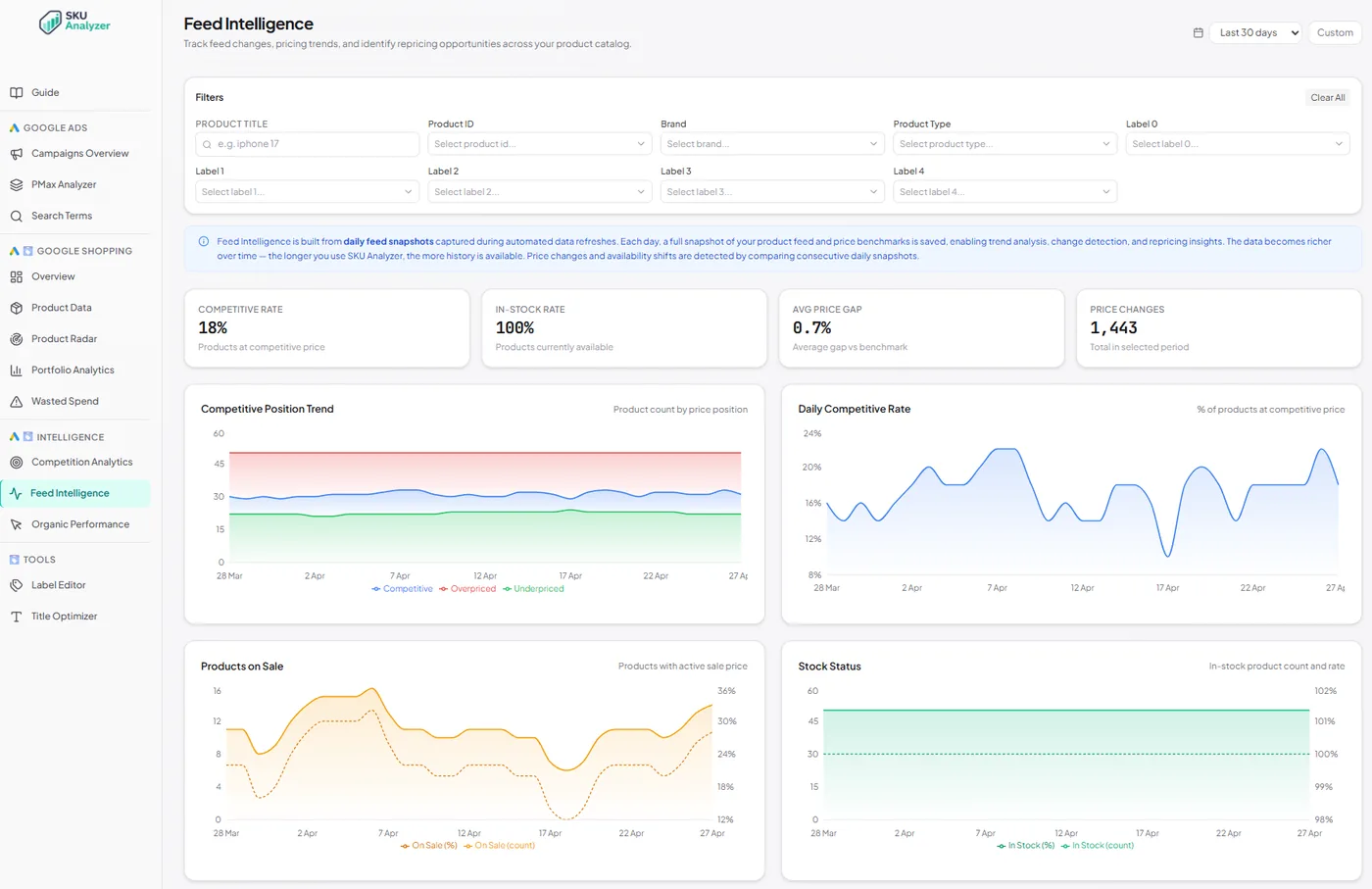
Concretely, that is the difference between these two stacks:
What the feed tool owns
- Pulling the catalog out of your store
- Rules, transformations and enrichment
- Formatting per destination and syndicating
- Catching feed errors before disapprovals spread
What SKU Analyzer adds on top
- Which products spend budget and return nothing
- Whether your price moved against competitors, daily
- Who outranks you per Google Shopping category
- What a title or feed change actually did to performance
- Where Performance Max is really spending, by channel
Each of those is a question about the join between feed data and performance data, which is why a feed tool cannot answer it and why the Google Ads interface cannot either — it has the spend but not the feed context. For most serious Shopping advertisers the working stack ends up being one of each: a feed tool for data quality and syndication, and an analytics layer for what the data went on to do.
Product Feed Tools FAQ
What is product data feed software?
Product data feed software is a platform that connects your e-commerce product catalog to advertising channels and marketplaces. It pulls product data from your store, transforms it into each channel's required format, applies optimization rules to titles and attributes, and syndicates the feed to Google Shopping, Amazon, Facebook, and other destinations. Leading product data feed software includes Channable, Feedonomics, DataFeedWatch, GoDataFeed, and Productsup.
Which tool is best for uploading item data to ad platforms?
DataFeedWatch is the best choice for most advertisers uploading item data to ad platforms, with the strongest support for Google Shopping, Microsoft Advertising, and Meta at mid-market pricing. Channable is better if you upload to many destinations at once or combine ad platforms with marketplaces. Feedonomics handles the uploading for you through managed service. Note that you rarely upload item data to an ad platform directly: Google Ads reads items from Merchant Center, Microsoft Advertising from Microsoft Merchant Center, and Meta from a Commerce Manager catalog. A feed tool's real job is keeping all of those catalog layers in sync from one product source. If deciding whether the second catalog is worthwhile, compare Google Shopping with Microsoft Shopping before adding another destination. If you only upload to a single ad platform and your catalog is small and clean, your store's free built-in connector is enough.
What is the best product feed management software for e-commerce?
The best product feed management software depends on your e-commerce setup. DataFeedWatch is the strongest choice for SMBs focused on Google Shopping. Channable leads for agencies and multi-marketplace sellers, especially in Europe. Feedonomics offers premium managed-service feed management for large retailers. GoDataFeed provides the most affordable entry point. Productsup handles enterprise-scale global catalog management. All five qualify as top-tier e-commerce feed management platforms.
Which product feed platform is best for Google Shopping?
DataFeedWatch is widely considered the best product feed platform for Google Shopping, with purpose-built optimization features for Merchant Center feeds including title A/B testing, feed auditing, and custom label automation. GoDataFeed is a strong budget alternative. For enterprises that want hands-off Google Shopping feed management, Feedonomics provides dedicated specialists who manage your feed directly.
How much do product feed management tools cost in 2026?
Pricing splits by tool type. Free native connectors cost nothing, while store apps use product, order, site or feature limits. Feed platforms with clear published entry prices include ShoppingFeeder at $20/month, DataFeedWatch at €54, Feedoptimise at $59, Channable at €59, GoDataFeed at $99 and Shoptimised at £119.99. Only Lengow, Feedonomics and Productsup require a quote. Figures checked against vendor pricing pages in August 2026.
Do I need a dedicated ecommerce feed tool or can I use my platform's built-in solution?
A dedicated ecommerce feed tool becomes necessary when your platform's built-in solution can't handle advanced title optimization, multi-channel syndication, or complex transformation rules. If you sell on Google Shopping only with under 500 products and a clean feed, your Shopify or WooCommerce plugin may suffice. But once you need to optimize titles for search relevance, manage feeds across multiple channels, or fix persistent disapprovals, a dedicated product feed tool pays for itself through better ad performance.
What features should I look for in Google Shopping feed management tools?
Essential features in Google Shopping feed management tools include: a visual rules engine for title and attribute optimization, automatic error detection and feed auditing, custom label generation for campaign segmentation, GTIN and product identifier management, inventory sync to prevent availability mismatches, and A/B testing for product titles. Advanced Google Shopping feed management tools also offer performance analytics, competitor price monitoring, and supplemental feed support for pushing changes without modifying your primary feed.