
Two protocols are competing to become the standard for AI-powered commerce. Google and Shopify have launched the Universal Commerce Protocol (UCP). OpenAI and Stripe have rolled out the Agentic Commerce Protocol (ACP). Both let AI agents buy products on behalf of consumers, but they take very different approaches.
Two Protocols, Two Visions for AI Commerce
UCP
Universal Commerce Protocol
- ● Google + Shopify co-developed
- ● Search-to-buy journey
- ● 20+ launch partners
- ● Decentralized discovery
ACP
Agentic Commerce Protocol
- ● OpenAI + Stripe partnership
- ● Chat-to-buy journey
- ● Instant Checkout in ChatGPT
- ● Centralized approval
Google's UCP and OpenAI's ACP represent two competing visions for how AI agents will handle commerce
If you sell products online, this is not a theoretical debate. These protocols will determine how your products get discovered, presented, and purchased through AI interfaces. Merchants who understand both protocols early will have an advantage as agentic commerce scales.
This guide breaks down both protocols side by side, explains where each one wins, and tells you what to prioritize as an e-commerce advertiser. If you have not yet read the UCP explainer, start there for the full background on Google's protocol.
What Is UCP?
The Universal Commerce Protocol (UCP) is Google's open-source standard for enabling AI agents to discover, evaluate, and purchase products across the web. Google announced UCP on January 11, 2026, at the National Retail Federation (NRF) conference, alongside major partners including Shopify, Etsy, Wayfair, Target, and Walmart.
UCP is designed around the search-to-buy journey. It lives inside Google Search AI Mode and Gemini, where users can discover products, compare options, and complete purchases without leaving the AI interface. The protocol covers the full shopping experience, from product discovery through checkout and post-purchase support.
The discovery model is decentralized. Merchants expose their product data through a /.well-known/ucp endpoint on their domain, combined with their existing Google Merchant Center feeds. This means any merchant can participate without needing explicit approval from Google. Over 20 partners were onboard at launch, and the UCP specification is published as open source under the Apache 2.0 license.
Key Takeaway
UCP builds on infrastructure you likely already have. If you run Google Shopping campaigns, your Merchant Center feed is the starting point for UCP readiness. Learn more in the product feed readiness guide.
What Is ACP?
The Agentic Commerce Protocol (ACP) is OpenAI's framework for enabling AI-powered purchases inside ChatGPT. OpenAI launched ACP on September 29, 2025, in partnership with Stripe, which handles the payment infrastructure through delegated payment tokens.
ACP is designed around the chat-to-buy journey. When a ChatGPT user asks for a product recommendation, the AI can surface matching products and enable an Instant Checkout experience directly within the chat interface. The focus is primarily on the checkout moment rather than the full shopping journey. Discovery happens through the natural flow of conversation.
Unlike UCP's decentralized approach, ACP uses a centralized model. OpenAI approves merchants who want to participate, and products are surfaced through ChatGPT's own recommendation engine. Payment processing runs exclusively through Stripe's delegated payment tokens, which means merchants need a Stripe integration to participate.
ACP is also open source. Shopify merchants can connect through Shopify's Agentic Storefronts feature, which provides a native integration path. However, the overall ecosystem is smaller and more curated than UCP's open-access approach.
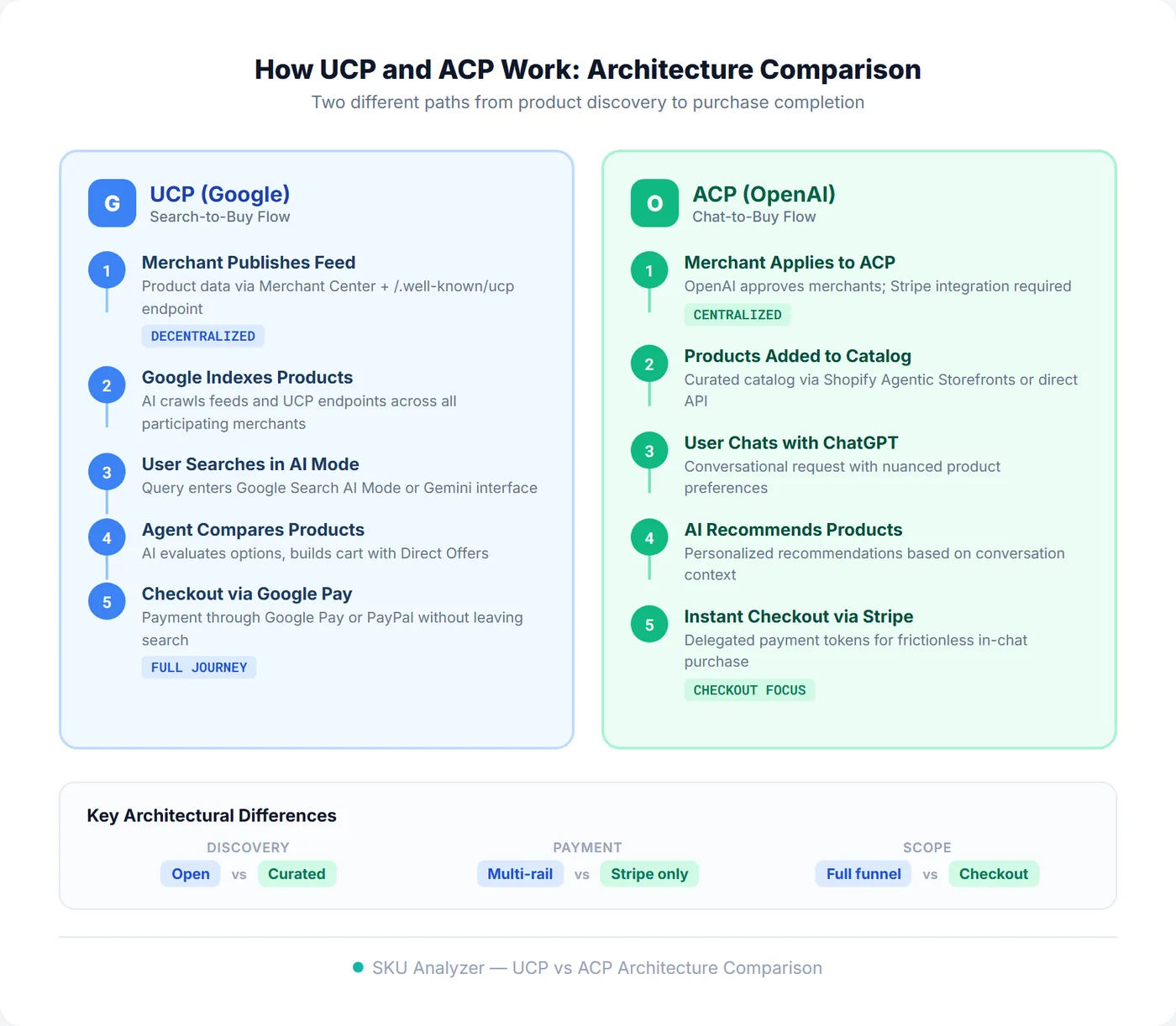
Head-to-Head Comparison
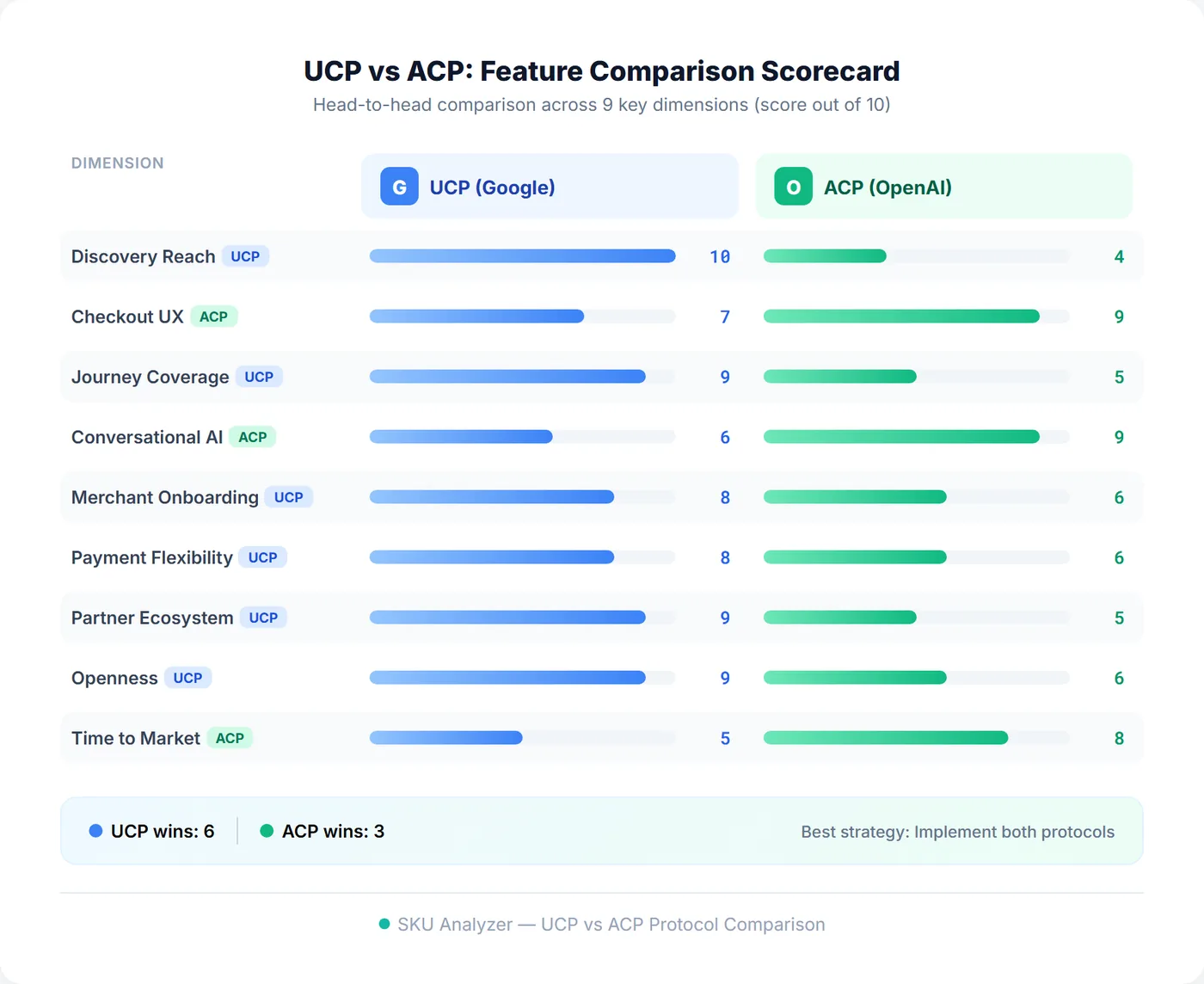
Here is how UCP and ACP compare across the dimensions that matter most to e-commerce merchants:
| Dimension | UCP (Google) | ACP (OpenAI) |
|---|---|---|
| Launch Date | January 11, 2026 | September 29, 2025 |
| Primary Use Case | Search-to-buy | Chat-to-buy |
| Lives In | Google Search AI Mode + Gemini | ChatGPT |
| Discovery Model | Decentralized (/.well-known/ucp + Merchant Center) | Centralized (OpenAI approves merchants) |
| Payment Rails | Google Pay, PayPal | Stripe (delegated payment tokens) |
| Scope | Full shopping journey (discovery through post-purchase) | Checkout-focused |
| Platform Dependency | Google ecosystem | OpenAI ecosystem |
| Shopify Integration | Native instant checkout | Native via Agentic Storefronts |
| Open Source | Yes (Apache 2.0) | Yes |
The table makes the fundamental difference clear. UCP is a broad, decentralized protocol built to integrate with Google's massive search ecosystem. ACP is a focused, curated protocol designed to monetize ChatGPT's conversational interface. They overlap in concept but differ significantly in execution. For the full technical specification of UCP, see the Google UCP developer documentation.
Where Each Protocol Wins
UCP's Strengths
- Search and discovery intent: Google handles billions of product searches daily. UCP plugs directly into that existing demand, which means your products are found by people already looking to buy.
- Global reach potential: Google Search operates in virtually every market worldwide. As UCP rolls out globally, the addressable audience dwarfs any single chat platform.
- Full shopping journey coverage: UCP covers the entire funnel: product discovery, comparison, cart building, payment, and post-purchase support.
- Merchant Center integration: If you already run Google Shopping campaigns, your product feed is the foundation for UCP. There is no starting from scratch. This is especially important for existing Shopping advertisers who have spent years optimizing their product feeds for Google Shopping and tracking product-level performance.
ACP's Strengths
- Conversational commerce depth: ChatGPT excels at understanding nuanced, complex purchase intent. A user can describe exactly what they want in natural language and get tailored recommendations.
- Checkout simplicity: ACP's Instant Checkout is streamlined and focused. Stripe's payment infrastructure is proven at scale, and the checkout friction is minimal.
- Stripe ubiquity: Millions of merchants already use Stripe. If you are one of them, ACP integration requires less net-new infrastructure than you might expect.
- Earlier to market: ACP launched four months before UCP. Early adopters have had more time to learn, iterate, and optimize their presence in ChatGPT commerce.
The "You'll Need Both" Reality
This is not a VHS versus Betamax situation where one protocol kills the other. It is more like iOS versus Android: two ecosystems that coexist, serve different user bases, and require different strategies.
UCP captures top-of-funnel discovery intent. When someone searches "best running shoes for flat feet" in Google AI Mode, UCP is what surfaces your product. ACP captures deep-funnel conversational intent. When someone tells ChatGPT "I need a gift for my sister who just started running, she has flat feet, budget is $150," ACP powers that recommendation and checkout.
These are different customer journeys happening in different moments. A single consumer might use Google AI Mode for research and ChatGPT for a personalized recommendation the same week. Your products need to be discoverable in both contexts. If you already manage campaigns across Google and Microsoft Shopping, think of UCP and ACP as two more surfaces to cover.
Practical Advice
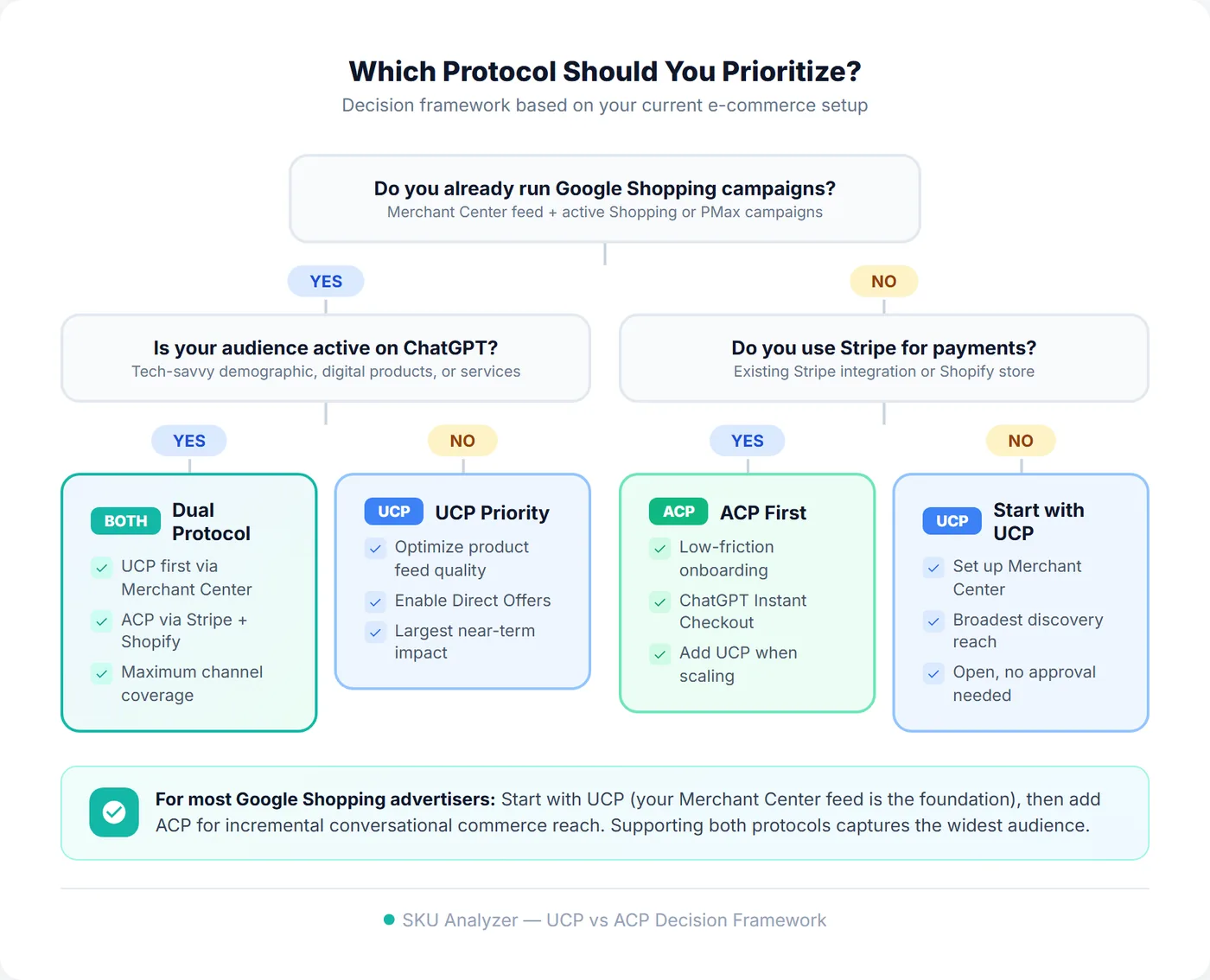
If you sell on Google Shopping AND have ChatGPT-discoverable products, prepare for both protocols. Prioritize UCP if Google Shopping is your primary channel, but do not ignore ACP entirely. The merchants who support both will capture demand that single-protocol competitors miss.
What About Amazon?
The elephant in the room is Amazon, which is conspicuously absent from both protocols. Amazon has blocked OpenAI's web crawlers, distanced itself from Google's UCP initiative, and by all accounts is "violently against" both protocols. That means over 600 million products are missing from AI commerce discovery entirely.
Amazon is almost certainly building its own agentic commerce solution. The company has invested heavily in Alexa's AI capabilities and launched Rufus, its AI shopping assistant, within the Amazon app. A proprietary Amazon agentic protocol that keeps transactions inside the Amazon ecosystem fits their walled-garden strategy.
For non-Amazon merchants, this gap is an opportunity. While Amazon's massive catalog sits outside AI commerce, your products can fill that void. If you sell products that compete with Amazon listings, UCP and ACP give you visibility that Amazon sellers currently do not have. That window will not stay open forever, so the advantage goes to merchants who move now.
What This Means for Google Shopping Advertisers
If you run Google Shopping campaigns, UCP is the protocol that matters more for your business in the near term. Here is why and what to focus on.
Your Merchant Center feed is already the foundation. UCP pulls product data from the same feeds you use for Shopping ads. Every attribute you have optimized (titles, descriptions, images, pricing, availability) directly powers your UCP presence. You are not starting from zero.
Direct Offers is the new ad format to watch. This is Google's native advertising unit within AI Mode, and it is built on UCP. Direct Offers sit alongside the new Shopping ad format that also appears directly inside AI Mode, letting users purchase your products without leaving the AI conversation. If Performance Max is your primary campaign type, Direct Offers will likely become a significant extension of that strategy.
Traditional metrics may evolve. CPC and CTR were designed for a click-through world. In agentic commerce, the "click" might be an AI agent adding your product to a cart. Expect new metrics around agent impressions, agent-initiated conversions, and agent-assisted revenue — see the AI agent revenue tracking guide for how to attribute this today. Today's competition and pricing benchmarks will remain essential for understanding how AI agents evaluate your products against competitors. Even today, understanding why last-click ROAS already misleads Shopping campaign decisions is critical preparation for the attribution challenges agentic commerce will bring. Getting comfortable with this shift now gives you a head start.
Feed quality becomes the number one competitive advantage. When AI agents compare products on behalf of users, they rely entirely on structured data. Vague titles, missing attributes, and incomplete descriptions make your products invisible. Feed intelligence tools help you identify and fix these gaps. Tools like SKU Analyzer help you track product-level performance and identify which products have the strongest feed data, giving you actionable insight into where to focus your optimization efforts. If you are evaluating product feed management tools to improve your data quality, that investment becomes even more critical in an agentic commerce world.
Feed Quality Is the Priority
In a world where AI agents mediate purchases, your product feed is your storefront. Invest in feed completeness, accuracy, and optimization now. See the feed readiness checklist for a step-by-step audit of your UCP preparedness.
Frequently Asked Questions
Should I adopt UCP or ACP first?
If you already advertise on Google Shopping, prioritize UCP. Your Merchant Center product feed is the foundation for UCP discovery, and Google's ecosystem already drives the majority of product search traffic. If your audience skews toward ChatGPT-heavy demographics or you sell digital products and services where conversational checkout is a natural fit, ACP may be worth exploring in parallel. For most e-commerce businesses, UCP will have the larger near-term impact.
Can I use both UCP and ACP at the same time?
Yes. UCP and ACP are not mutually exclusive. They operate on different platforms (Google vs ChatGPT) and serve different moments in the customer journey. You can implement UCP through your Merchant Center feed and Google Shopping setup while simultaneously enabling ACP through Stripe and Shopify's Agentic Storefronts. Think of it like listing products on both Google Shopping and Amazon—different channels, complementary reach.
Is Amazon going to create its own agentic commerce protocol?
Amazon has not announced a formal agentic commerce protocol, but all signs point in that direction. Amazon has blocked OpenAI's crawlers, distanced itself from both UCP and ACP, and continues to invest heavily in its own AI capabilities through Alexa and Rufus. Given Amazon's walled-garden strategy and massive product catalog, a proprietary agentic commerce layer built into the Amazon ecosystem is a strong possibility within the next 12 to 18 months.
Will agentic commerce replace traditional e-commerce?
Not in the near term. Agentic commerce will add a new layer on top of existing e-commerce infrastructure rather than replacing it. Your product feeds, checkout systems, and fulfillment processes remain the backbone. What changes is how customers discover and initiate purchases—through AI agents instead of manual search and browsing. Think of agentic commerce as a new sales channel, similar to how social commerce added a layer without replacing web stores.