
Feedonomics and Channable are two of the most popular product feed management tools on the market, but they take very different approaches. Feedonomics is a premium, managed-service platform where dedicated specialists handle your feeds. Channable is a self-serve platform with broad marketplace coverage and built-in PPC automation. Choosing between them comes down to your team, your budget, and where you sell.
This guide compares both tools across features, pricing, service model, channel coverage, and ease of use. Whether you run a small store selling on Google Shopping or an enterprise brand active across 20+ marketplaces, there is a clear recommendation for your situation below. For a broader look at the full market, see the product feed tools comparison.
Quick Overview: Feedonomics vs Channable
Before getting into the details, here is a high-level look at what each platform offers and who it serves best.
Feedonomics was founded in 2014 and acquired by BigCommerce in 2021. It positions itself as a full-service feed platform. You get the software plus a team of feed specialists who set up, monitor, and optimize your feeds on your behalf. It claims 2,000+ channel destinations spanning ad platforms, marketplaces, and AI shopping surfaces. Pricing is custom and enterprise-oriented, typically starting in the hundreds per month.
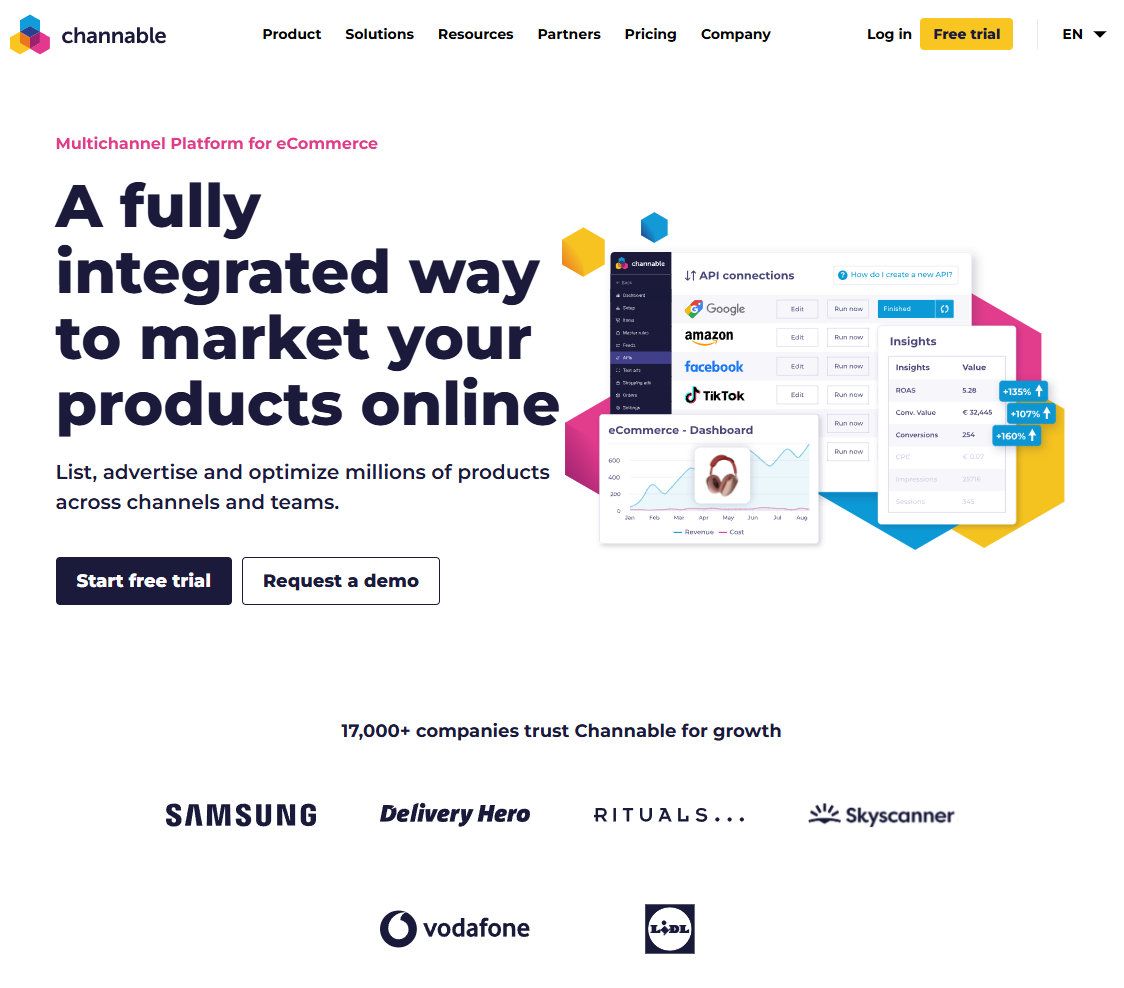
Channable is a Netherlands-based platform that launched in 2014. It takes a self-serve approach: you manage everything through an intuitive interface with a visual rules engine. It advertises 3,000+ channels and templates, with particularly strong European coverage (Bol.com, Zalando, Otto, and more). Beyond feed management, Channable sells PPC automation, marketplace order sync, and analytics — but these are separate paid modules layered on a Core plan, not bundled into it. Core pricing starts at roughly €49/month and scales by product count and channels.
Treat both channel counts as marketing numbers
2,000+ and 3,000+ are each vendor's own headline figure, and they are not counting the same unit — a "destination" can mean one marketplace, or one marketplace per country. The gap between them is not a real measure of coverage. More on what actually separates the two below.
| Dimension | Feedonomics | Channable |
|---|---|---|
| Founded | 2014 (acquired by BigCommerce 2021) | 2014 (Netherlands) |
| Service Model | Managed service + software | Self-serve software |
| Channel Count (vendor claim) | 2,000+ destinations | 3,000+ channels |
| Pricing | Custom enterprise ($$$$) | Tiered from ~€49/mo ($) |
| Target Market | Mid-to-large retailers | SMBs to enterprise, agencies |
| Strongest Region | North America | Europe |
Feature-by-Feature Comparison
Both platforms cover the essentials of feed management, but they differ in scope and approach. Here is how they stack up across nine key dimensions.
| Feature | Feedonomics | Channable |
|---|---|---|
| Feed Creation & Formatting | Specialists build and maintain feeds for you | Visual interface to create and map feeds yourself |
| Rules Engine | Powerful, but specialists typically configure rules | Visual, drag-and-drop rules builder with if/then logic |
| Channel Support | 2,000+ destinations (Google, Amazon, Meta, Walmart, TikTok, AI surfaces) | 3,000+ channels (strong EU marketplace coverage) |
| Feed Optimization | Handled by specialists; title optimization, attribute enrichment | Self-serve; rule-based title building, attribute mapping |
| PPC Automation | Not offered | Yes — generate Google/Microsoft Ads from feed data (paid PPC module) |
| Order Management | Not offered | Yes — sync marketplace orders (paid Marketplaces module) |
| Error Monitoring | Proactive; specialists catch and fix feed errors | Automated alerts; you investigate and resolve |
| Analytics & Reporting | Feed health dashboards, channel performance | Insights and Analytics, but only on the top Core Pro tier |
| AI/Automation | AI-assisted categorization, attribute mapping | Smart rules, automated product categorization |
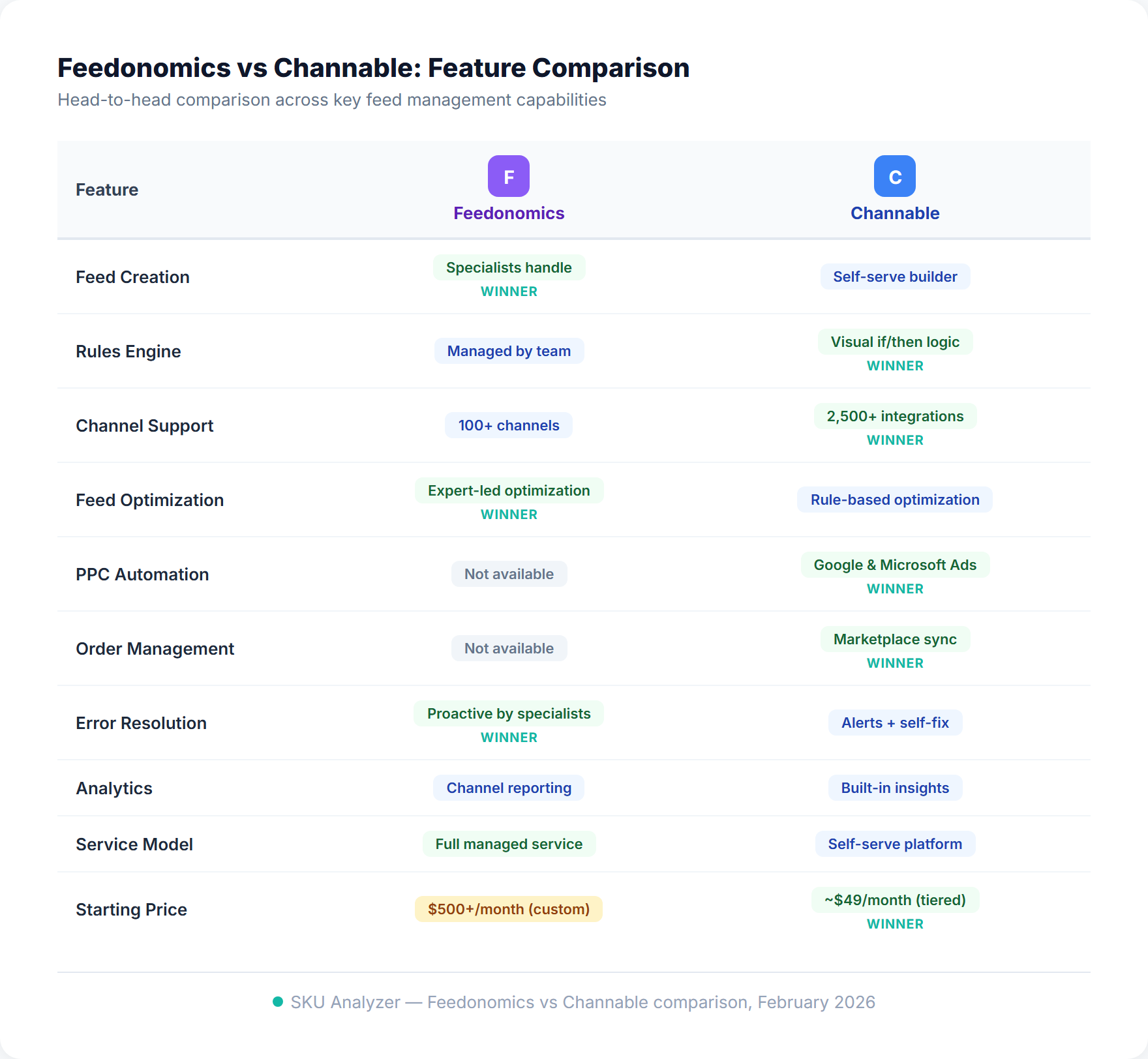
The biggest functional gap between the two is scope. Channable reaches beyond feed management into PPC automation and order management, making it a more complete ecommerce operations tool — provided you buy those modules. Feedonomics stays focused on feed quality and syndication, but adds human expertise to the equation.
Pro Tip
If you need PPC campaign generation alongside feed management, Channable is the only option of the two. Feedonomics is a pure feed tool, so you will need separate software for campaign creation and bid management.
Pricing Comparison
Pricing is one of the starkest differences between these two platforms. They serve overlapping markets but at very different price points.
Channable Pricing
Channable publishes its pricing, which already puts it ahead of Feedonomics on transparency. A Core plan is the base subscription, priced by item count, projects, and connected channels, and comes in Standard, Plus, and Pro tiers starting at roughly €49/month. A mid-size retailer with 10,000-50,000 products across several channels lands in the low hundreds per month. There is a free trial, so you can test before committing.
The number to watch is what the Core plan excludes. PPC automation, marketplace order sync, Creatives, and CSS are separate paid modules, and Channable Insights and Analytics only appear on the top Core Pro tier. The advertised €49 buys feed management; the configuration most people picture when they read "Channable does PPC too" costs meaningfully more. Price the modules you actually need, not the headline.
Feedonomics Pricing
Feedonomics does not publish pricing. All plans are custom-quoted based on catalog size, number of channels, and service level. Based on industry reports and G2 reviews, expect starting prices in the range of $500-1,000/month for smaller accounts, scaling to several thousand per month for large catalogs. The managed service (dedicated feed specialists) is baked into the cost, which is why the price is higher.
Think About Total Cost of Ownership
Feedonomics looks expensive on paper, but consider the alternative: with Channable, you need internal staff to manage feeds. If you would need to hire a feed specialist (or allocate significant hours from your existing team), the effective cost gap narrows. For teams that already have feed management expertise in-house, Channable is clearly the better value.
| Cost Factor | Feedonomics | Channable |
|---|---|---|
| Software Cost | $500-5,000+/month (estimated; not published) | €49-500+/month for Core; modules extra |
| Setup Fee | Often included in contract | None |
| Internal Staff Needed | Minimal (specialists handle feeds) | Yes (self-serve management) |
| Contract Length | Typically annual | Monthly or annual |
| Free Trial | No (demo available) | Yes |
Service Model: Self-Serve vs Managed
This is the defining difference between Feedonomics and Channable, and it should be the first question you ask when choosing between them.
Feedonomics: Managed Service
When you sign up with Feedonomics, you get a dedicated team of feed specialists assigned to your account. They handle initial feed setup, ongoing optimization, error resolution, and channel-specific formatting. You provide the product data and business goals; they do the technical work. This is ideal for retailers who lack feed management expertise internally or whose team is stretched too thin to manage feeds properly.
The downside is less control and slower iteration. If you want to test a new custom label strategy or restructure your product titles, you need to communicate those changes to your Feedonomics team and wait for implementation. You can not simply log in and make the change yourself in most cases.
Channable: Self-Serve Platform
Channable gives you the tools and lets you drive. You set up your own feed connections, build your own rules, map your own attributes, and troubleshoot your own errors. The platform provides documentation, templates, and support, but the day-to-day management is on you (or your team).
The advantage is speed and flexibility. You can test changes instantly, spin up new channel feeds in minutes, and iterate on feed optimization strategies without waiting on anyone. For agencies managing multiple client accounts, this self-serve model is almost always preferable.
Key Takeaway
Choose Feedonomics if you want someone else to handle your feeds and you are willing to pay for that convenience. Choose Channable if you have an internal team capable of managing feeds and you want direct control over every optimization.
Channel and Marketplace Coverage
Channel counts are the most quoted numbers in this comparison and the least useful. Channable advertises 3,000+ channels; Feedonomics advertises 2,000+ destinations. Both are self-reported, neither is audited, and they do not count the same unit — a platform that counts Zalando once and a platform that counts Zalando in each of fourteen countries will report very different totals for identical coverage. Treat the gap between the two headline numbers as noise.
Channable: Deep in the European Long Tail
Channable's coverage spans marketplaces, comparison shopping engines, affiliate networks, and advertising platforms, and its real strength is regional European breadth: Bol.com, Zalando, Otto, Fnac, Cdiscount, Allegro, eMAG, and a long tail of smaller national platforms. If you sell across multiple EU countries and push to regional marketplaces, this is the more likely fit. For more on marketplace tools, see the marketplace feed tools guide.
Feedonomics: Broad Global Coverage, Plus AI Surfaces
Feedonomics covers the major global channels well — Google Shopping, Amazon, Meta, Walmart, Target, eBay, Pinterest, TikTok — and its directory does list the large European marketplaces, including Bol.com and Zalando with multi-country support. It has also moved early on AI shopping surfaces, which is where its "destinations" number is growing fastest. Where it thins out is the smaller national platforms: several of the regional marketplaces Channable names are not listed in Feedonomics' public channel directory.
So the honest version is narrower than the numbers suggest. Both tools will syndicate to every channel most retailers actually use. The difference only bites if your list includes regional European marketplaces beyond the big names, and the way to settle that is to check your own list against each vendor's directory rather than compare headline totals.
| Channel Type | Feedonomics | Channable |
|---|---|---|
| Google Shopping | Yes | Yes |
| Amazon | Yes | Yes |
| Facebook/Meta | Yes | Yes |
| Walmart | Yes | Yes |
| European Marketplaces | Major ones (Bol.com, Zalando); thinner in the national long tail | Extensive (Bol.com, Zalando, Otto, Fnac, Cdiscount, Allegro, eMAG) |
| Comparison Shopping Engines | Major ones | Extensive coverage |
| Affiliate Networks | Some | Yes, broad coverage |
Pro Tip
Before choosing a tool, list every channel and marketplace you currently sell on (or plan to within the next 12 months). Then look each one up in Feedonomics' channel directory and Channable's integrations list. A tool with 3,000 integrations is only better if those integrations include your channels.
Ease of Use and Learning Curve
The ease-of-use question is a bit paradoxical with these two tools, because they solve the complexity problem in opposite ways.
Channable: Moderate Learning Curve, High Control
Channable has an intuitive visual rules builder that lets you create feed transformations without writing code. Most marketing teams can learn the basics within a few days and become proficient within a couple of weeks. The interface is well-organized, and the documentation is solid.
That said, getting the most out of Channable takes time. Building advanced rule chains, optimizing product titles across multiple channels, and configuring marketplace-specific attributes all require learning. The platform gives you the power, but you need to invest time to use it well.
Feedonomics: Low Learning Curve, Less Hands-On
Because Feedonomics is a managed service, the learning curve for your team is minimal. You do not need to master a rules builder or understand Google Merchant Center feed specifications in depth. Your Feedonomics specialists handle the technical details. You mostly interact through meetings, emails, and a dashboard that shows feed health and performance.
The trade-off is that you are dependent on your account team. Need a quick change at 4 PM on a Friday? You are waiting until someone is available. With Channable, you can make that change yourself in minutes.
Which Tool Wins? (By Use Case)
There is no single winner. The right tool depends on your specific business context. Here is a breakdown by common scenarios.
| Use Case | Winner | Why |
|---|---|---|
| Small ecommerce (<1,000 SKUs) | Channable (or alternatives) | Feedonomics is overkill and overpriced for small catalogs |
| Mid-size retailer (1K-50K SKUs) | Depends on resources | Channable if you have a capable team; Feedonomics if you do not |
| Enterprise with internal team | Channable | More control, lower cost, broader channel coverage |
| Enterprise wanting hands-off | Feedonomics | Managed service lets you focus on strategy, not feed mechanics |
| Agencies | Channable | Multi-client management, self-serve flexibility, PPC automation |
| European marketplace sellers | Channable | Deeper coverage of regional EU marketplaces beyond the big names |
| BigCommerce stores | Feedonomics | Native integration after BigCommerce acquisition |
| Businesses needing PPC + feeds | Channable | Has a PPC module (paid add-on); Feedonomics does not offer PPC at all |
Verdict Summary
Channable wins on value and scope. It costs a fraction of Feedonomics, publishes its prices, and can extend into PPC and order management if you buy those modules. Feedonomics wins on service. If you want experts handling your feeds so your team can focus elsewhere, the premium is justified. On raw channel coverage, treat it as a draw for most retailers — the vendor counts are not comparable. For enterprise retailers considering both, also see the Productsup vs Feedonomics comparison for how Feedonomics stacks up against another enterprise option.
What Neither Tool Covers
Both Feedonomics and Channable are strong feed management platforms. But feed management and feed analytics are different problems, and neither tool goes deep on the analytics side.
| Capability | Feedonomics | Channable |
|---|---|---|
| Multi-channel feed syndication | 2,000+ destinations | 3,000+ channels |
| Feed transformation rules | Yes | Yes |
| Performance-based custom labels | Feed-attribute rules only | Feed-attribute rules only |
| SKU-level analytics dashboard | No | Basic (Insights, Core Pro only) |
| Price benchmarking with daily history | No | No |
| Competitive visibility by category | No | No |
| Title optimization with impact tracking | No | No |
| Feed change tracking | No | No |
| Search term analysis | No | No |
| PMax channel decomposition | No | No |
If your primary need is getting clean, optimized product data to multiple channels, Feedonomics or Channable is the right investment. If you also need to understand how your products are performing, where you're losing to competitors on price and visibility, and whether your feed changes actually improved results — that's a separate category of tool.
Analytics-focused options include ProductHero for performance-based labeling and PMax insights (see ProductHero alternatives if you need more flexibility), Optmyzr for broader PPC management with Shopping analytics, and SKU Analyzer for deep SKU-level analytics with custom label automation, title optimization, competitive visibility, and feed intelligence. Most serious Shopping advertisers end up using both a feed tool and an analytics tool — they solve different problems.
Frequently Asked Questions
Is Feedonomics worth the premium over Channable?
It depends on your team and catalog complexity. Feedonomics is worth the premium if you lack internal feed management expertise, have a large catalog with persistent data quality issues, or want a hands-off approach where dedicated specialists handle optimization. If you have an in-house team comfortable with self-serve tools, Channable delivers comparable feed quality at a lower cost.
Does Channable really support more channels than Feedonomics?
Not in any way you can rely on. Channable advertises 3,000+ channels and Feedonomics advertises 2,000+ destinations, but both are self-reported figures counting different units, so the gap is not a real coverage difference. Both syndicate to every channel most retailers use. Channable is genuinely deeper in the regional European long tail; Feedonomics has moved earlier on AI shopping surfaces. Check your own channel list against each vendor's directory rather than comparing headline totals.
Can Channable replace Feedonomics for large catalogs?
Yes. Channable handles large catalogs (100,000+ SKUs) effectively and many enterprise retailers use it as their primary feed tool. The key difference is that you need internal resources to manage feeds yourself with Channable, while Feedonomics includes dedicated specialists. If you have a capable ecommerce or marketing team, Channable can replace Feedonomics at a lower cost.
Which tool is better for Google Shopping specifically?
Both tools handle Google Shopping well. Channable has a slight edge because its PPC module can generate and manage Google Ads campaigns directly from your feed, though that module is a paid add-on rather than part of the base plan. Feedonomics focuses purely on the feed side, so you would manage campaigns separately. For Google Shopping feed optimization alone, both are equally capable.
Does Feedonomics work with Shopify?
Yes. Feedonomics integrates with Shopify, Shopify Plus, BigCommerce, WooCommerce, Magento, and most major ecommerce platforms. Since BigCommerce acquired Feedonomics in 2021, the BigCommerce integration is the tightest, but Shopify merchants can use Feedonomics without issues. Channable also supports all major ecommerce platforms.
What are cheaper alternatives to both Feedonomics and Channable?
DataFeedWatch is the strongest mid-market alternative, starting around $64/month with excellent Google Shopping optimization. See the DataFeedWatch vs Channable comparison for details. GoDataFeed starts at roughly $39/month for smaller catalogs. For very small stores, Shopify's native Google channel app or WooCommerce plugins may be enough. Check the product feed tools comparison for a full breakdown of alternatives at every price point.
Verdict
Feedonomics and Channable are both excellent feed management platforms, but they serve different needs. The recommendation breaks down like this:
Choose Channable if: you have an internal team to manage feeds, you sell on European marketplaces, you want PPC automation alongside feed management, you are an agency managing multiple clients, or you want transparent pricing without long-term contracts.
Choose Feedonomics if: you want experts handling your feeds end-to-end, your team does not have feed management expertise, you have a complex catalog with persistent data quality issues, you use BigCommerce, or you are happy to pay a premium for a hands-off experience.
For smaller stores that find both options too expensive, DataFeedWatch and GoDataFeed are strong alternatives. See Channable alternatives for more budget-friendly options.
Whichever tool you choose, remember that feed management is only half the equation. After your feeds are optimized and syndicating correctly, you need to track how individual products perform. Monitoring ROAS at the product level, identifying wasted spend, and understanding competitive dynamics are all necessary to maximize your return. SKU Analyzer connects your Google Ads and Merchant Center data to give you that SKU-level visibility, complementing whichever feed tool you use.